
blurblog 2, second in our series on the long and tempestuous love affair between Britain and Blur. For blurblog 1 – go here.
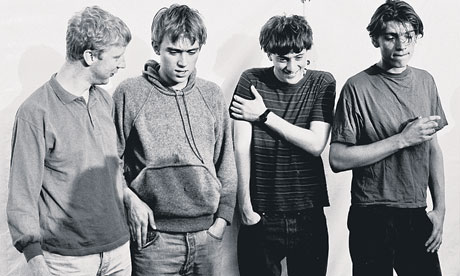
Seymour, sorry, Blur, 1991. Photograph by Geoffrey Swaine/Rex Features
Writing this in 2012, it’s astonishing to think how close Blur came to being a minor footnote in pop history, just another Airhead or Soup Dragons, with a single hit to their name followed by a rapid exit into the obscurity which is the fate of 99% of bands. Just as the Soup Dragons are most “famous” now because one of their members went on to become TV scientist Brian Cox, Blur could have become most “famous” because one of them went on to be a Labour MP. Because although Britain did fall in love with Blur in 1991, it was one of those brief infatuations that soon curdled into “what were we thinking?” scorn.
There are plenty of other websites and blogs recounting the early history of Blur, so we’ll be brief. We won’t dwell on Damon Albarn’s hippy childhood, his social discomfort in an Essex comprehensive school (which obviously shaped his uneasy songwriting relationship with the working class, his hunger to be embraced by the masses, while never quite preventing a sneer creeping over his features) or the outrageous musical talent he revealed from a frighteningly young age.
Others too have recounted Albarn’s pivotal meeting with Graham Coxon at school and discovery of Alex James at London’s Goldsmiths College, as well as the band’s early uncertain steps. It is worth briefly considering the band’s first name, Seymour, however. For decades, historians have entertained themselves by asking whether Adolf Hitler could have come to power and the horrors of WW2 unfolded if he had still gone by his family’s original name of Schicklgruber. Would the German nation have really been able to embrace the cry of “Heil Schicklgruber”? Similarly, could Blur have really become such a deep and engrained part of our pop life if they’d been called Seymour, could that name have been chanted across Hyde Park on Sunday instead of Blur?
Parlour games aside, the band got signed, and their label insisted on changing their name and rushed their first album, “Leisure”, into production. It’s worth taking a moment here to think about the musical world of UK indie which Blur emerged into 1990. If you weren’t around (lucky you!), close your eyes and picture a vast, muddy field, with only a few flowers blooming, far apart and forlorn. Got it? Then you’ve got British indie pop in 1990. Continue reading










 poplifer.com